
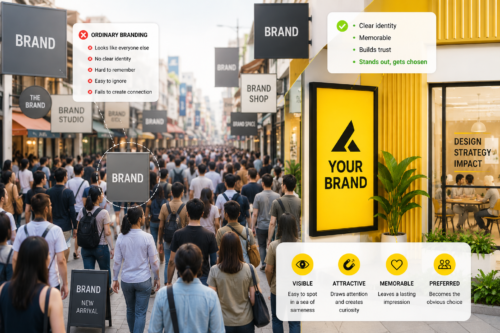
I have seen many businesses invest heavily in marketing but still struggle to gain attention. They run ads, create content, and maintain a presence across multiple platforms. Yet somehow, they remain unnoticed. The problem is not always budget or effort. Often, it comes down to one critical issue, their branding feels ordinary.
In today’s crowded market, being average is not neutral. It is a disadvantage. When your brand looks and sounds like everyone else, people have no reason to remember you. You do not stand out, and more importantly, you do not stay in their mind.
What is Ordinary Branding
Ordinary branding is not necessarily bad in quality. In fact, many brands with ordinary branding are well designed and professionally executed. The issue is not execution, it is differentiation.
Ordinary branding often shares similar traits:
- Generic color palettes that follow current trends
- Safe and predictable typography
- Messaging that uses common industry phrases
- Visuals that resemble competitors
At first glance, this approach feels safe. It avoids risk and ensures that nothing looks out of place. However, this safety comes with a hidden cost. It makes your brand forgettable.
The Danger of Blending In
Blending in might seem harmless, but it creates a serious problem. If your audience cannot distinguish your brand from others, they will not remember you when it matters.
Human memory works through contrast. People remember what is different, not what is similar. When every brand in your industry uses the same style, tone, and messaging, they start to merge into one.
The real danger is this:
- You are not compared, you are ignored
- You are not rejected, you are forgotten
- You are not chosen, you are overlooked
In many cases, being invisible is worse than being disliked. At least strong reactions create awareness. Ordinary branding does neither.
The Role of Visual Identity
Visual identity plays a huge role in how a brand is perceived. Colors, typography, and design elements shape first impressions within seconds.
The problem arises when brands rely too heavily on trends. While trends can be useful for staying current, they often lead to uniformity. When everyone follows the same design direction, originality disappears.
I have noticed this especially in industries like hospitality, wellness, and fashion. Many brands adopt similar minimalist aesthetics, neutral tones, and clean layouts. While these choices look modern, they also look identical.
Strong visual identity should do more than look good. It should be recognizable. It should feel uniquely yours.
Messaging That Sounds Like Everyone Else
Beyond visuals, messaging is another area where brands lose their uniqueness. Many businesses rely on familiar phrases that feel safe but lack personality.
Common examples include:
- We provide the best quality
- Customer satisfaction is our priority
- We deliver innovative solutions
- Your trusted partner
These statements are not wrong, but they are not distinctive either. Almost every brand claims the same thing.
When messaging lacks personality, it fails to create connection. People do not engage with generic statements. They respond to authenticity, clarity, and emotion.
The Comfort Zone Trap
One of the biggest reasons brands stay ordinary is comfort. Playing it safe feels logical, especially when there is pressure to appeal to a wide audience.
However, this mindset creates limitations:
- Fear of being different
- Over reliance on competitor benchmarks
- Internal approvals that dilute bold ideas
I have seen situations where creative concepts are simplified repeatedly until they lose their original impact. The result is branding that feels polished but uninspiring.
Standing out requires a willingness to take calculated risks. Without it, brands remain stuck in the middle.
How Strong Branding Actually Stands Out
Strong branding is not about being loud or extreme. It is about being clear and intentional.
Brands that stand out often share these qualities:
- A clear identity that reflects who they are
- A consistent voice across all platforms
- Visual elements that are distinctive and memorable
- Messaging that feels human and relatable
What makes these brands effective is not just creativity, but alignment. Everything works together to create a cohesive experience.
At this point, it is worth exploring how branding and design can elevate your visibility.
Read also : Stand Out with Effective Branding and Design
When branding is done right, it creates recognition, trust, and emotional connection. It becomes more than just appearance. It becomes a strategic asset.
Practical Ways to Break Out of Ordinary Branding
If you feel your brand is blending in, there are practical steps you can take to change that.
1. Define What Makes You Different
Start by identifying what truly sets your brand apart. This is not just about products or services, but perspective and values.
2. Develop a Distinct Voice
Your tone of communication should reflect your personality. Whether it is bold, friendly, or insightful, it needs to feel consistent and authentic.
3. Rethink Your Visual Direction
Instead of following trends blindly, focus on creating a visual identity that is recognizable. This could involve unique color combinations, custom typography, or unconventional layouts.
4. Understand Your Audience Deeply
Differentiation becomes easier when you know who you are speaking to. Insights into your audience help shape messaging that resonates.
5. Be Consistent Across All Touchpoints
Consistency builds familiarity. When your branding is aligned across platforms, it becomes easier for people to recognize and remember you.
The Balance Between Unique and Relevant
While standing out is important, it should not come at the cost of relevance. Being different without purpose can confuse your audience.
The goal is to find a balance:
- Unique enough to be memorable
- Clear enough to be understood
- Relevant enough to connect
This balance ensures that your branding is not only creative, but also effective.
Conclusion
Ordinary branding does not fail in obvious ways. It fails quietly by making your business invisible in a crowded market.
From my perspective, the biggest shift comes when businesses stop trying to fit in and start focusing on what makes them distinct. This does not mean abandoning strategy. It means strengthening it with clarity and creativity.
In a world where attention is limited, being remembered is everything. And that only happens when your branding gives people a reason to notice you.


